Tuesday, October 6, 2009

Creole Theater, Contemporary Problems


Metropolitan French know the French West Indies, or Antilles, for their white sand beaches and limpid waters. French West Indians know their home is anything but a paradise. The festival of “Creole” theater now ending at the Parc de La Villette offers a compelling explanation for this disparity, painting a vision of life in Guadeloupe and Martinique that is far removed from tourist brochures and clichés. Two plays, both by Guadeloupean women writers, unflinchingly take on the searing issues facing Antillean society today: unemployment, delinquency, drug abuse and crime among young men and the ravages of these combined social ills on women of all ages.

These are not well-worn topics in Antillean theater. Whether in French or in Creole, French West Indian writers and directors have concentrated their attention over the last 50 years to fighting economic and political oppression by the former colonizer, turned “homeland” (patrie) in 1946. That “Trames”, by Gerty Dambury, and “Comme deux frères” by novelist Maryse Condé, turn to these pressing and very contemporary domestic issues is significant, and testament to their importance for female agency in Antillean society.

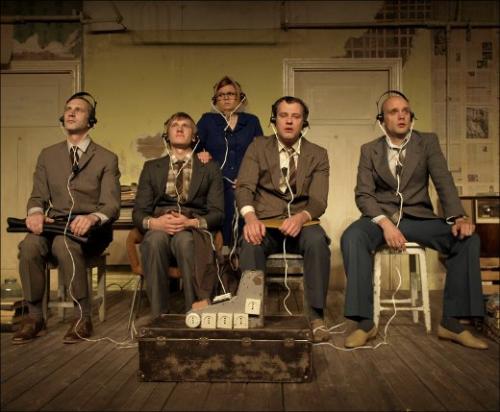
“Trames” is the story of a mother-son relationship poisoned by the latter’s inability to hold a job and his subsequent drug use and descent into crime. Although Christian’s mother is an accomplished and well-traveled researcher, with a specialty in women’s narratives (spouse abuse, prostitution, rape, etc.), Christian cannot manage to shake off the heritage of an absent father and take responsibility for himself. Claiming frustration with what he perceives as his mother’s privileging of her work over the problems of her progeny, he robs her of her dearest possessions, then murders her when she asserts her freedom, by telling him in no uncertain terms, “You are not my final destination.” Dambury places on the lips of her heroine a terribly bold statement for an Antillean mother to say to her child, yet it is the only one this women can make if she is to liberate herself from yet another man attempting to wield power over her. In that final act of rebellion, the playwright makes an equally telling statement about Guadeloupean society, where the new turf lords are adolescent males and the latest victims their mothers and grandmothers who tirelessly worry about them, feed them, clean them up and bail them out of trouble. Directed by Dambury, the production which just closed, starring Firmine Richard, was tight, controlled and excellently acted, with a fine supporting cast: Jalil Leclaire as the lost and angry Christophe and Martine Maximin, as a kind of women’s wisdom personified and who also makes an astonishing performance as a prostitute/interviewee.

“Comme deux frères” which runs this week, adopts a similar theme but, under the direction of José Exilis, does not pack nearly the same punch. The text, published in 2007, is a small revelation nevertheless: two friends awaiting trail for murder share the secrets of their pasts in a jailhouse confession that serves as a reminder of the same social problems, here on a grander scale: school, government, religion, the police and above all the family are remiss in their duty to raise a morally grounded younger generation; worse, these institutional actors are the perverse tools of a society gone to wreck and whose victims again include women: the teenage mothers and abused lovers these young men leave in the wake of their destruction. In a powerful, penultimate scene, the friends struggle with a Faustian pact: Jeff, who has always taken the blame for Greg’s failures, will agree to plead sole guilt for the murder if Greg will sleep with him, a deal the macho Greg cannot bear to accept, in part because of his surprise at the discovery of his friend’s parallel life. Maryse Condé has always been a writer of the tough realities of life in France’s tropical paradise. In this play, she develops a provocative metaphor: because Greg has screwed Jeff over these many long years he owes his friend a **ck for getting him out of an equally **cked up situation. In her indictment of contemporary Guadeloupean society, Condé shows that this impossible situation is shared by the community at large.

Unfortunately for Condé’s message, the production by Martinique’s Compagnie Siyaj is marred by a surprisingly blatant casting error: while the text treats clearly with young delinquents, Exilis has chosen to cast his longtime collaborator, 61-year old Gilbert Laumord, as Jeff. While Laumord is a talented actor and dancer, the choice creates an insurmountable problem of representation, added to by the soulful notes Jeff plays on the harmonica and his poetically tortured dance steps. The text, in its perverse pact and the dangerously insatiable will to live of Greg, demands the irresistible energy, uncompromising anger and pulsating music of youth. Exilis has created something more akin to a meditation on crime, where a fragmented dance interrupts the friends’ musings, on a bare stage that dispenses with the cramped promiscuity of the pair’s jail cell : necessary here to convey their descent into the existential pit from which they will never escape.

Dambury’s riveting production and Exilis’ failed opportunity can be taken as immediate evidence that contemporary Antillean theater may be both closer to current realities and farther yet from creating a viable esthetic than may have been supposed.

“Comme deux frères” to Oct. 10, Tues, Wed, Fri, Sat, 8:30 pm, Thurs, 7:30 pm, Grande Halle de la Villette, Parc de la Villette (19e), Mº Porte de Pantin, info: www.villette.com or tel: 01.40.03.75.75.

Photo credits: "Trames", Emir Srklovic; "Comme deux frères", Philippe Bourgade

Thursday, September 24, 2009

Exterior Views: “I Went To The House But Did Not Enter”


The self is the defining notion of post-industrial society : the watershed of modern art, literature and psychology since Picasso, Joyce and Freud, the modus operandi of contemporary society and the yardstick of its tangential pop cultures. T. S. Eliot was one of the first to actively engage a multiple and fractured self in modern poetry, beginning with “The Lovesong of J. Alfred Prufrock” (1911/17) and its inward-directed invitation to explore painful zones of feeling and emotion, while taking care, paradoxically, to eliminate these from his poetry. This he did through what he termed the “objective correlative”, or “a set of objects, a situation, a chain of events which shall be the formula of that particular emotion; such that when the external facts, which must terminate in sensory experience, are given, the emotion is immediately evoked.” The technique was demonstrated to disturbing effect in “Prufrock”’s etherized patient and insistent coffee spoons, filling in for numbness and frustration, but opened a new poetic field whereby the self could just infuse the objective world of the poem, and in so doing, allow the artist to access a state of necessary impersonality.

These concerns lie at the core of “I Went to the House But Did Not Enter” , an intriguing hybrid piece by German director/composer Heiner Goebbels. Constructed on four thematically intersecting texts spanning the last century, the show, a “staged concert” in the now signature style of its creator (after “Eraritjaritjaka”, 2004), explores the convergent concerns of its authors to challenge the tyranny of personality and the validity of language’s attempt to master human experience. Sung a cappella with virtuoso gravity and control by the Cambridge-based Hilliard Ensemble (2 tenors, 1 countertenor, 1 baritone), these texts offer immediate applications of Eliot’s literary theories. The series of three tableaux begins with “Prufrock”, here a study in grey where the bank clerk’s objectified insignificance in the eyes of his society is forcefully rendered by the Hilliards’ efficient packing and unpacking of a drawing room’s various objects in black and white. It continues to Maurice Blanchot’s short novel “La folie du jour”, first written in 1948, as a response to the losses and terrors of war (during which Blanchot narrowly escaped execution) and a testament to the writer’s ability to live tranquilly with constant suffering (the “madness of the day”) by removing himself from experience itself. This middle section is spoken primarily by the Hilliard Ensemble and comes the closest to resembling theater, but reintroduces the objective correlative in the looming form of an architecturally British looking house facade, with illuminated interiors of four rooms. It segues next to Franz Kafka’s very brief and characteristically humorous meditation on the individual’s isolation in society, “An Excursion into the Mountains” (1912), before finishing, where it must, with Samuel Beckett and his late monologue “Worstward Ho” (1983).

Goebbels has said his interest in “staged concerts” stems from a search for “alternatives to concepts of presence and intensity, the individual and absence” and the desire to explore these with “cinematic reality” in a way that avoids emotional subjectivity. In other words, using a kind of objective correlative to arrive at an intensity of feeling in the absence of an authorial self. In Goebbel’s visual language, this can translate into settings which appear to be of no relation to the words being spoken, such as in the “Worstward Ho” tableau, placed in a plush red upholstered hotel room interior. But Goebbels reserves an ingenious surprise in the form of a “slide show” whose frozen glimpses of human life fade into footage of a running river. The still-life of “Prufrock’s” arrested anxiety becomes an affirmation of life, in Beckett’s enigmatically hopeful mantra: ”Ever tried. Ever failed. No matter. Try again. Fail again. Fail better”.

“I Went To The House But Did Not Enter”, in English with French subtitles, Sept. 23-27, 8:30 pm, Théâtre de la Ville, 2 place du Châtelet, 4e, Mº Châtelet, 15€/26€, tel: 01.42.74.22.77.

Photo Credit: www.heinergoebbels.com

Monday, January 26, 2009

France’s Invisible Africa


What does a thirtyish, white French intellectual know about Africa? The question is hardly the stuff of drama, yet playwright Ronan Chéneau and director David Bobee make of Chéneau’s struggle to answer it an intriguing performance. Chéneau and Bobee manage to satisfy a commission to write a text for dancers about the African presence in France, while essentially skirting it, Chéneau’s search leading him to the France of the banlieue riots of 2005 and of Nicolas Sarkozy’s Ministry of National Identity in 2008, and to his own position within that same society.

In Chéneau’s own account, he was living and writing in a medium-size French city, his major preoccupations art and love, when the commission arrived. If Africa was still only a dark continent on the edges of his imagination, a brief trip to Brazzaville, organized by the Centre Culturel Français there, helped him contextualize what he had only heretofore glimpsed via the media, as well as put him in touch with a Congolese choreographer, DeLaVallet Bidiefono. Read by Chéneau, this autobiographical narration serves as the mildly satirical preface to a performance that attempts through dance, video and acrobatics to poeticize a radically (for French theater) politicized discourse on the exclusive and draconian policies on integration and immigration of Sarkozy’s government, as well as a generalized racism and prevailing cultural chauvinism.

In the second, the health preoccupations and wide-eyed impressions of the French tourist thrown out of his Gallic fishbowl give over to self-loathing at being French and a wholesale rejection of France, at least such as Sarkozy has imagined it. “I hate France” is declaimed under a faded French flag; another point-blank statement, “I died the day I learned of the creation of the Ministry of National Identity”, is the prologue to a machine gun massacre of innocents to the tune of the Marseillaise.

Chéneau and Bobee never nuance their sentiments, and yet they fail to identify a focus of their resistance, hesitating between the related, yet different issues of social and economic integration of French citizens of immigrant descent, national immigration policy and race relations. While powerful, particularly in the acrobatic sequences and the revolutionary energy of the finale, the performances of the talented Franco-Congolese cast never entirely shake off a feeling of undirected displacement, mirrored by the airport boarding hall in which the piece is set, nor of self-conscious posturing, in the figure of Chéneau’s narrator and in the accumulation of politically-aimed punches.

But if the last word belongs to Chéneau, his conclusion to his struggle to find the “invisible” Africa in France, both provides hope and indicates with lucidity the road left to travel: “I dream of a day when Congolese and French will speak about the same world, with emotion, in peace and serenity. We will be Congolese and French; we will speak of the same world.” A world where, even in France, color and ethnicity will no longer mark division, but create community.

“Nos enfants nous font peur quand on les croise dans la rue”, to Feb. 14, Théâtre de Gennevilliers, 41 avenue des Grésillons, Gennevilliers (92), Mº Gabriel Péri, 5 euros-22 euros, tel: 01.41.32.26.26.
March 4-11, 8:30 pm, Maison des arts de Créteil, Place Salvador Allende, Créteil, Métro Créteil-Préfecture (shuttle bus return to Place de la Bastille following show), 4-20 euros, tel : 01 45 13 19 19 or www.maccreteil.com.

Photo credit: Tristan Jeanne-Valès

Wednesday, June 4, 2008

"Boliloc"


You won’t find the meaning in the dictionary or even in the show of the same by Philippe Genty. “Boliloc” is an imaginary trip through time, space, memory and even the human body, meeting creatures both grotesque and fanciful, in cosmic, organic and fantastic settings. Ostensibly the story of a ventriloquist put to the test by her rebellious dummies, the show leaves the door wide open to individual interpretation. So it is with Genty, the French puppeteer famous the world over for magical, mind-bending quests in search of his multiple selves. As in shows like “Voyageur immobile” and “Passagers clandestins” (1995-1999), developing the theme of the interior voyage, he places the unconscious at the heart of all of his work. His explorations can make for dumbfounding, enchanting spectacles. In “Boliloc” however, Genty fails to excite; except for a burlesque strain developed with Belgian actor Christian Hecq, the piece brings little that is new to a familiar vocabulary of dance, marionettes, acrobatics and set design, developed over the past 30 years. Still, some nice images and enough wonders to please neophytes.

To June 29, Tues-Sat, 8:30 pm, Sun, 3 pm (no show June 8), Théâtre du Rond-Point, 2 bis, avenue Franklin D. Roosevelt, 8e, Mº Franklin D. Roosevelt, 16,50€-33€, tel: 01.44.95.98.21.

Photo Credit: Pascal François

Wednesday, May 28, 2008

"La Théorie de l'Echec"


Le spectateur de la pièce “La Théorie de l’échec” a l’impression d’avoir découvert un nouveau talent. Hichem Djemaï, étudiant en histoire à Paris X-Nanterre, est l’auteur de ces scènes drôles, touchantes, acerbes parfois, dans lesquelles une petite bande d’amis réunis autour d’un banc de jardin nous émeuvent sur leur quotidien : banale et décevant à leurs yeux, mais colorié par tant d’espoir et délavé par autant d’échecs. Les textes sont le fruit d’une Option théâtre au Lycée Joliot Curie de Nanterre en 2004-05, sous la direction d’Élodie Chanut, qui les met en scène aujourd’hui au Théâtre des Amandiers. Il y a Idriss, le meneur du bal, confiant et rieur ; Malik, qui plaque sa petite amie parisienne parce qu’il a le sentiment désagréable de « jouer un jeu » quand il est avec elle; Walid, collégien qui veut faire comme les grands mais dont le rap finit par forcer l'admiration de tous; Morgane, une « gothique » qui se passionne pour Racine… On parle profs et meufs, ciné et cité, boîte de nuit et carte d’électeur… Ils sont vrais, débordent de vitalité et de projets, se font piéger par leurs faiblesses et leurs peurs. Bien que la pièce dépeigne une certaine tranquillité qui serait plus caractéristique de Nanterre que d’autres communes plus sensibles, dans le « 9-3 » par exemple, le langage de Djemaï, sa musicalité comme sa « muscle », et un formidable jeu d’acteurs nous font découvrir la banlieue loin des clichés et des violences gratuites.

Jusqu’au 7 juin, mardi-samedi 21h, représentations supplémentaires les 29 et 30 mai, 3, 5 et 6 juin, à 15h, Théâtre Nanterre-Amandiers, 7 avenue Pablo Picasso, Nanterre (92), RER A Nanterre Préfecture + navette, 10€-24€, tél : 01. 46.14.70.00.

Visionner un extrait vidéo de la pièce en suivant ce lien:
http://109.2.nanterre.net/index.php?2006/11/21/66-hichem-djemai-la-theorie-de-lechec

Read this article in English by following this link:
www.parisvoice.com/index.php?option=com_content&task=view&id=521&Itemid=35

Thursday, April 17, 2008

"Amour"


Qu’est-ce qu’il y a d’ « Amour » dans le spectacle du même nom, l’adaptation du roman « Amour, Colère, Folie » (1969) de Marie Vieux-Chauvet ? Passion, haine, peur, certes ; mais d’amour, très peu. Il est pourtant dans son absence notoire que réside toute la force de cette œuvre maîtresse de la littérature haïtienne, écrite pendant les années noires de la dictature duvaliérienne. Scabreux pour l'époque, le roman fut censuré par la famille de l’auteur, ainsi provoquant l’exil de Marie Vieux et la divorce du couple Chauvet, pour avoir osé relater l’histoire d’une « vieille fille », Claire, l’ainée des sœurs Clamont, qui manoeuvre ses cadettes comme autant de pions dans l’espoir de calmer le feu qui risque de les consumer toutes depuis que le beau Jean-Luz s’est installé sous leur toit. Or, ce n’est pas sur Claire que l’employé français de l’Import-Export Corporation a jeté son dévolu, d’où cet étrange « Amour » qui se découvre aussi machiavélique qu’intempestif.

L’adaptation signée par José Pliya, dramaturge franco-béninois et l’actuel directeur de l’Artchipel, Scène nationale de la Guadéloupe, ainsi que la mise en scène de Vincent Goethals, rendent un bel hommage à l’esprit révolté du texte de Vieux-Chauvet, donnant libre cours aux fantasmes de Claire tout en l’emprisonnant derrière ses persiennes, victime des préjugés (elle est plus noire de peau que les autres membres de la famille) et des rigidités de sa classe (qui la destine à veiller sur ses soeurs à la place de la mère défunte). L’éternel témoin du bonheur des autres qu’elle ne peut pas partager, Claire ne se résigne pourtant pas à l’effacement, ni à l’oubli : si c’est Félicia qui se trouve enceinte de Jean à « sa » place, c’est elle qui jouera l’épouse dévoyée pendant la convalescence de la jeune maman, attirant le mari comblé sur son propre lit pour jouer avec l’enfant, dont elle a fait installer le berceau dans sa chambre en prenant bien soin de ranger ses cartes postales pornographiques...

L’intimité inviolable de Claire se juxtapose aux images d’époque de Port-au-Prince (marchés, palais national, cathédrale), projetées sur un écran serpentin et modulable selon l’humour de Claire et devant lequel un jeune homme habillé alternativement en costume noir et caleçon blanc exécutera de temps à autre des pas de danse saccadés, disloqués presque : le pantin du rut inassouvi de Claire ou bien son propre double. Lorsque « l’amour » rancit pour se distiller enfin en rage, Claire prend le micro pour hurler son dépit, sa frustration et sa passion, qu’elle ne trouvera jamais le courage de déclarer à Jean, ainsi que sa peur des Tonton-Macoutes qui guettent une brèche dans la façade de la « vieille-fille » en dentelle pour lui faire avouer des histoires de famille, enterrées jusque-là. La pièce s’achève sur fond de révolution populaire, dont l’ambiance générale sera enfin digne des passions que vit Claire depuis de longues années dans la solitude de sa chambre et d’un sexe resté vierge trop longtemps.

Magali Comeau Denis donne une interprétation magistrale dans le rôle de Claire , la rendant aussi attachante qu’amère, nous entraînant avec autant de finesse que de brusquerie dans les tourments de Claire, à l’image de la sœur ignorée qui se finit la maîtresse d’un jeu qui faillit lui échapper pour de bon. José Pliya décrit le roman de Vieux-Chauvet comme « une grande œuvre chorale et intimiste » : c’est en jouant sur ces contrastes que la pièce trouve son équilibre et sa force.

Jusqu’au 19 avril, 20h, Tarmac de la Villette, Parc de la Villette (derrière la Grande Halle), 19e, M° Porte de Pantin, tél : 01.40.03.93.95.

Crédit photo: Eric Legrand

Wednesday, February 20, 2008

La France de Mohamed Rouabhi


Mohamed Rouabhi a un sens inné de l’ironie. “Fils d’indigènes” selon sa propre formule, qui a vu le jour dans cette France des Trente glorieuses, construite en grande partie par des milliers d’immigrants qui ont eu droit à peu de splendeurs dans les mines et les baraques surpeuplés, Rouabhi a tout lu, tout entendu et tout enregistré surtout, des comportements politiques et sociaux du « pays des droits de l’homme » envers ceux qui ont eu la maladresse de ne pas y naître Français. « Vive la France ! », la pièce qu’il a écrite et mise en scène avec sa jeune compagnie Les Acharnés, n’exprime pas tant la dérision qu’elle frôle l’absurde dans son savant montage de films documentaires, cinéma, musique de variétés et rap, vidéo clandestin, publicités et discours politiques des cent dernières années en France. Rien ne lui échappe ; tout y passe : Exposition coloniale et tirailleurs sénégalais ; CRS et HLMs ; Annie Cordy et la Marianne, Aimé Césaire et Harry Roselmack, Carrefour et France 3; émeutes et brutalités policières ; Nicolas Sarkozy et Marine Le Pen… L’ironie est à son comble dans des séquences évoquant en les juxtaposant les fantasmes, les idéaux et la réalité de la société française contemporaine : à titre d’exemple, un extrait vidéo filmé en cachette montrant le tabassage d’un jeune par la police, suivi d’une déclaration d’amour aux forces de l’ordre, sur une mélodie pop des années 1970 (« Moi j'aime un galonné / Des Compagnies Républicaines de Sécurité / Et quand je suis entre ses bras rien ne peut m'arriver / Il est doux comme un agneau… »).

Le spectacle, qui prend néanmoins des longueurs pas tout à fait justifiées, fonctionne à la fois comme une machine à remonter le temps de l’Empire colonial, de l’Algérie en Indochine en passant par les Antilles, tout comme il entame une mûre réflexion sur les préjugés, les peurs et les stéréotypes qui définissent encore l’espace et l’identité octroyés par la France à ses citoyens black et beur. Or, pour Rouabhi, qui dit ne s’être jamais intéressé à l’histoire de France enseignée à l’école et qui aurait reçu l’inspiration d’écrire la pièce à l’époque où il habitait le dernier foyer Sonacotra en Ile de France, c’est marqué du sceaux indélébile du mépris – celui qui peut « laisser sans voix » l’objet de son dédain - que la pièce hurle son désarroi et sa colère. D’où l’importance de ce spectacle qui essaie, par une multitude de voix et de voies, de détruire le silence qui pèse encore sur l’époque coloniale et l’immigration en France, parce que « le mépris pour notre histoire, sera toujours un mépris pour nous-mêmes ».

Le projet de Rouabhi dépasse largement une simple esthétique théâtrale pour provoquer un sursaut collectif. Selon l’auteur, dans cette pièce (sa quinzième à ce jour), « il n’est plus question de reconnaissance. Il s’agit de faire appliquer les lois et d’en exiger d’autres. Il s’agit de mettre côte à côte tous les Français et de constater, malgré les apparences, que la seule chose qu’ils ont en commun aujourd’hui, c’est d’être français et qu’être français, ce n’est plus appartenir à une quelconque idée de la France, mais à une réalité : l’héritage de 150 années de colonialisme et d’émigration. »

« Vive la France ! » alors ; sur une entraînante musique rap chantée par quatre « jeunes des banlieues » transformés en loyaux soldats de la Mère-Patrie, la pièce de Rouabhi prend tout son sens : Vive la France à nous tous, celle qui revendique une devise célèbre qu’elle pourrait appliquer à tous ses enfants, irrespectueusement de la couleur de leur peau, si seulement elle se trouvait le fibre moral de le faire.

Jusqu’au 1er mars 2008
, du mardi au samedi à 20h, dimanche à 16h, Théâtre Gérard Philippe, 59 Boulevard Jules Guesde, Saint-Denis (93), Mº Saint-Denis Basilique/RER D Saint-Denis, 10€-20€, info/réservations :
 01 48 13 70 00.

Photo credit: Bellamy

See www.parisvoice.com for this review in English